
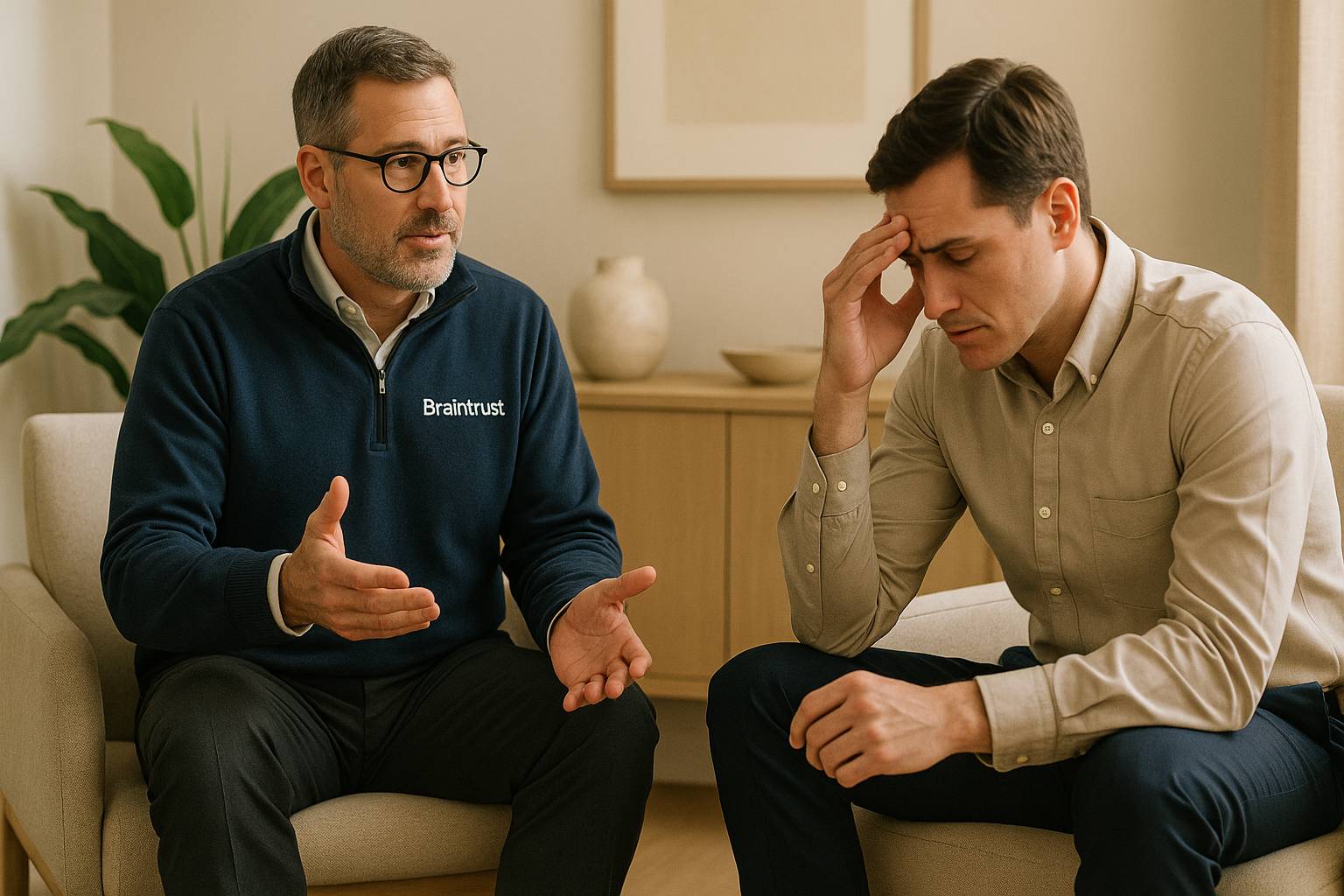
Lena was one of those leaders everyone admired: sharp, empathetic, and steady under pressure. But in our third coaching session, something cracked. Her voice lowered. Her eyes darted. "I'm exhausted. I'm second-guessing myself. I don't feel like I can keep this up." She hadn't lost her skillset. She'd lost her resilience.
And she's not alone. In today's high-stakes, high-speed world, even the most capable professionals hit cognitive overload. The pressure doesn't pause. The decisions don't slow down. The expectations keep rising. And at some point, the mental architecture that once held everything together starts to strain.
As coaches, this is one of our most urgent tasks: helping clients build not just confidence, but cognitive resilience. The ability to think clearly, stay grounded, and lead forward even when the pressure mounts.
What Is Cognitive Resilience?
Cognitive resilience is the brain's ability to adapt to adversity, regulate emotional response, and maintain focus in the face of stress. Unlike grit or raw toughness, it's not about force. It's about flexibility.
Neuroscience shows that resilience isn't just personality: it's plasticity. Through intentional practice, we can train the brain to rebound faster, manage uncertainty better, and avoid spirals of negative thought. The brain can be shaped, and coaching is one of the most powerful tools for doing that shaping.
At the core of this is the prefrontal cortex, the executive center of the brain responsible for decision-making, emotional regulation, and perspective-taking. When stress hits, the prefrontal cortex often goes offline, and the amygdala, our threat-detection center, takes over. The result is reactive, defensive, or avoidant behavior rather than clear, considered leadership.
Coaching for resilience is about getting the prefrontal cortex back online, again and again, until that recovery becomes a trained habit rather than a lucky outcome.
Why "Tough It Out" Fails Leaders
The traditional model of mental toughness is built on suppression: push harder, feel less, keep moving. It treats emotion as an obstacle and endurance as the goal. For a while, it works. Many high performers operate on this model for years before the cracks appear.
The problem is biological. Suppressing emotion doesn't eliminate it. It drives it underground, where it continues to consume cognitive resources. Research in affective neuroscience consistently shows that emotional avoidance increases physiological stress load rather than reducing it. The leader who "never lets anything bother them" is often carrying a significant, invisible tax on their executive function.
What looks like toughness from the outside is frequently the early stage of burnout. And burnout doesn't announce itself cleanly. It looks like defensiveness. It looks like short tempers. It looks like a leader who used to be great at decisions now second-guessing everything.
Lena wasn't weak. She was depleted. Those are very different problems with very different solutions.
The Coaching Opportunity
Coaching is uniquely suited to building cognitive resilience because it works at the intersection of awareness, language, and behavior, which are exactly the levers that neuroplasticity responds to. Unlike training programs that deliver content, coaching creates the reflective conditions where new neural patterns can form.
The five techniques below aren't theoretical. They're grounded in neuroscience, tested in high-performance coaching engagements, and built for real people under real pressure. Each one targets a specific mechanism in the brain's stress-response system. Together, they form a resilience playbook that coaches can draw from across any engagement.
Technique 1: Name It to Tame It
When emotions run high, naming them can reduce their intensity. Labeling an emotional experience engages the left hemisphere's language-processing systems and, in doing so, dampens activity in the amygdala. This isn't a metaphor. Brain imaging research consistently shows reduced limbic activation when individuals put words to what they're feeling.
The coaching application is precise: don't let clients stay at "stressed." Stressed is vague. Vague keeps the amygdala running. The more specific the label, the more the prefrontal cortex re-engages.
"What emotion are you feeling right now? Not just stress, what kind of stress? Is it fear? Frustration? Embarrassment? Something else entirely?"
Why it works: Precise emotional labeling activates the prefrontal cortex and reduces limbic hijack, restoring the mental clarity needed for sound decision-making. The more granular the vocabulary, the stronger the regulatory effect.
Technique 2: Cognitive Reframing
Our brains assign meaning to events constantly, and under pressure, the meaning almost always defaults to threat. A missed deadline becomes evidence of incompetence. A difficult conversation becomes proof that the relationship is broken. A setback becomes a sign of impending failure. The brain's negativity bias is doing what it evolved to do: keeping us alert to danger. But in a leadership context, it's often making things worse.
Reframing helps clients interrupt that automatic meaning-making and choose a more accurate, more useful interpretation. This isn't toxic positivity. It's cognitive accuracy: making sure the story the brain is telling is the most complete version of what's actually happening.
"What else could be true here? If this challenge were a teacher, what might it be trying to teach you? What's a more complete version of the story you're telling yourself right now?"
Why it works: Reframing activates neural circuits associated with optimism and adaptability, strengthening pathways that support both resilience and problem-solving under stress. Over time, the brain learns to generate alternative interpretations more automatically.
Technique 3: Future Simulation
One of the less visible casualties of sustained stress is time horizon. Leaders under pressure collapse into the immediate: the next meeting, the next crisis, the next decision. The future shrinks. And when the future shrinks, so does motivation.
Future simulation is the deliberate act of mentally projecting forward. The default mode network, the brain's imagination system, lights up when we envision future scenarios. Activating it creates psychological distance from current stress and re-engages the brain's reward-anticipation systems. In plain terms: imagining a positive future makes the present feel more navigable.
"Imagine it's six months from now, and you've moved through this challenge well. What's different? What did you learn about yourself? What would you tell yourself today from that vantage point?"
Why it works: Mental simulation increases psychological distance from current stress and restores motivation through reward anticipation. It also helps clients access their own future wisdom, which is often more credible to them than advice from an outside voice.
Technique 4: Recovery Rituals
Resilient leaders don't just perform well under stress. They recover well between it. The ability to recharge, mentally reset, and return to full cognitive capacity is not a personality trait. It's a practice. And like any practice, it can be designed.
Micro-recovery rituals are small, intentional actions that signal to the nervous system that the threat has passed. They don't require significant time. A five-minute walk. A deliberate transition between work modes. A single breath taken before picking up the phone. The neurobiological effect, reduced cortisol, restored attentional capacity, is real even when the ritual is brief.
"What are the tiny habits that help you reset, daily, weekly, and at the end of the workday? How do you know when your brain actually needs a break before you've hit the wall?"
Why it works: Intentional recovery reduces cortisol, boosts neuroplasticity, and protects long-term cognitive function. Leaders who treat recovery as a performance tool, not a luxury, sustain higher output over longer periods with fewer burnout episodes.
Technique 5: Strength-Focused Reflection
Under pressure, clients fixate on what's wrong. Their attention narrows to the gap between where they are and where they think they should be. That narrowing is another artifact of the threat-response system: it's efficient for survival but destructive for leadership performance.
Strength-focused reflection deliberately redirects attention to past resilience, core values, and identity-level resources. This isn't cheerleading. It's strategic activation of the hippocampus, memory's home, to retrieve evidence that the client has navigated hard things before. That evidence is more persuasive to the nervous system than any reassurance a coach can offer, because the client already lived it.
"Tell me about a time you handled something even harder than this. What did you draw on then? Which of your core strengths is most needed right now, and what would it look like to lead from that strength today?"
Why it works: Remembering past resilience activates the hippocampus and reinforces self-efficacy pathways. The brain recalibrates its threat assessment when it has access to a full inventory of its own capabilities, not just a snapshot of the current difficulty.
The Shift with Lena
Back to Lena. She didn't need a productivity system. She needed space to breathe and tools to process. Over several weeks, we worked through a resilience playbook built from the techniques above.
We named the deeper emotion: not just stress, but fear of being perceived as weak by the people who depended on her. We reframed her exhaustion: not as evidence of failure, but as a signal that her leadership was stretching into new territory. We built micro-practices into her week: a five-minute morning reset before the first meeting, a daily note of one thing that went well, and a deliberate "shut down" ritual at the end of each day that told her nervous system the work was done.
We returned often to her core belief: "I lead best when I'm grounded." And we used strength-focused reflection to retrieve the moments when she had been exactly that, even when everything around her was uncertain.
She didn't bounce back overnight. But she began making decisions from clarity rather than panic. She started sleeping better. Her team noticed the shift before she fully did. And by quarter's end, she said something she hadn't felt in a long time: "I feel strong again. Not because things got easier. But because I did."
Mental Toughness Is Flexibility
In coaching, we talk a lot about high performance. But sustained performance requires resilience: not just in the body, but in the brain. The leaders who perform at the highest levels over the longest periods are not the ones who feel nothing. They're the ones who have learned to feel it, name it, reframe it, recover from it, and come back stronger.
When we help clients build cognitive flexibility, emotional regulation, and reflective habits, we're not just improving their output. We're expanding their capacity. We're building the neural architecture for a kind of leadership that doesn't burn out, doesn't break under pressure, and doesn't mistake hardness for strength.
Mental toughness isn't about pushing through at all costs. It's about knowing when to pause, when to reframe, and how to reset. That's what makes resilience actually resilient.
If you're thinking about what it would look like to bring this kind of coaching to your leadership team, let's have a conversation.
