

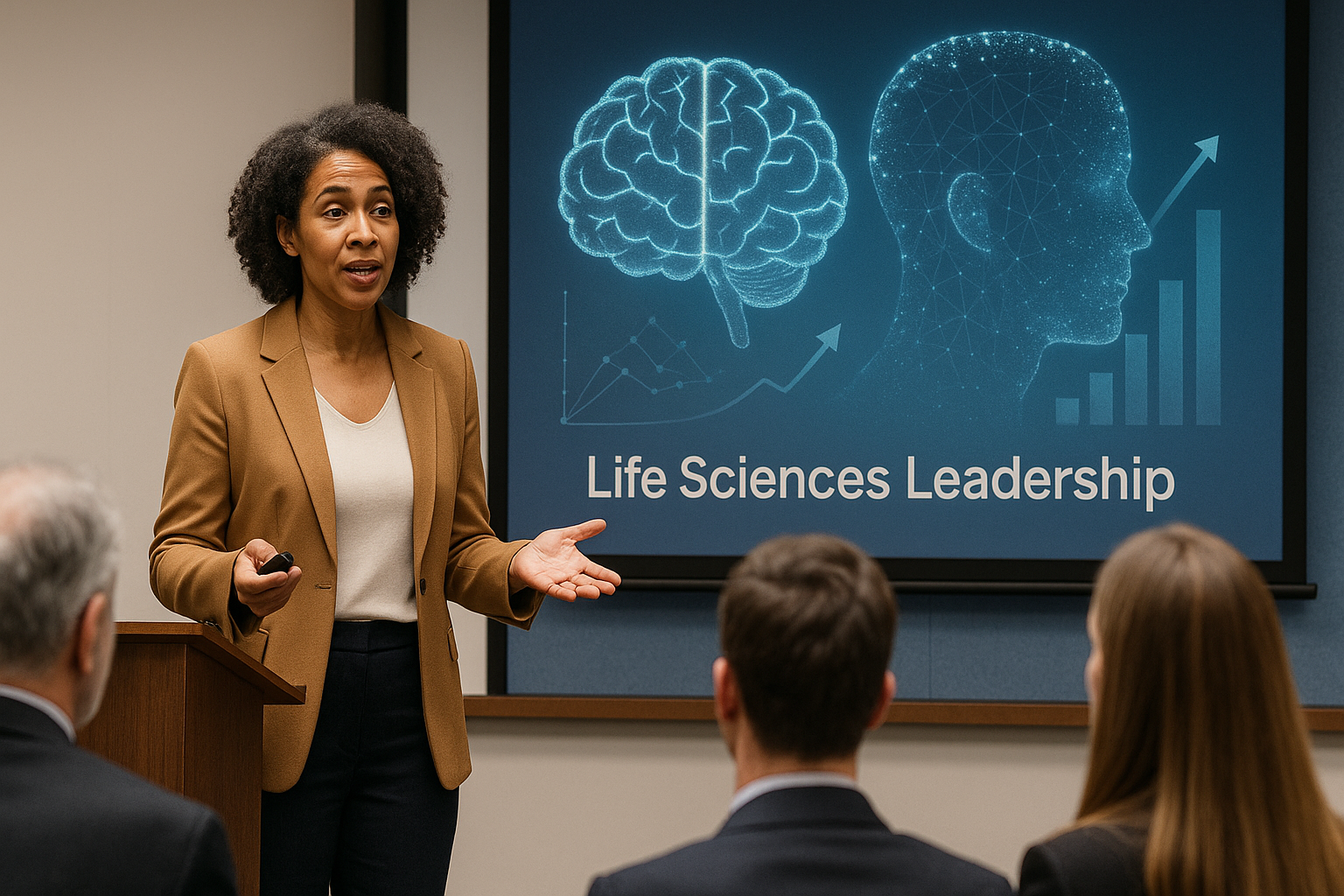
Life sciences has always been an industry built on purpose: advancing medicine, improving outcomes, and extending life. But in the rush to innovate faster, scale larger, and automate more, something deeply human has quietly slipped through the cracks.
Ironically, the very industry dedicated to healing people often struggles to nurture the emotional and relational health of its own teams. Yet neuroscience reveals that empathy isn't just a nice-to-have trait. It is a biological and strategic advantage. In an industry defined by intellect, regulation, and precision, empathy may just be the next true differentiator.
The Empathy Gap in Modern Life Sciences
Pharma, biotech, and med-tech organizations are filled with brilliant minds: scientists, clinicians, and strategists who thrive on solving complex problems. But those same environments can unintentionally reward analysis over connection, process over presence.
The culture that produces breakthrough science doesn't always produce breakthrough leadership. When organizations prioritize regulatory compliance and speed of discovery above everything else, the human dimensions of leadership, including listening, genuine belonging, and feeling understood, tend to get deprioritized. Not because leaders don't care. Because the signals they receive suggest these things are secondary.
The result? Teams that are highly capable but often emotionally disconnected. Surveys consistently show that employee engagement in life sciences lags behind other industries, despite high pay and purpose-driven missions. Why? Because engagement isn't built on compensation. It's built on connection.
This gap also surfaces in external relationships. Physicians and patients describe feeling processed rather than heard by pharma reps who lead with features instead of questions. Cross-functional teams in clinical development report that silos persist not because of structural barriers, but because no one is facilitating the trust conversations that would dissolve them.
When a scientist doesn't feel heard by their manager, when a medical affairs professional feels like a data point instead of a person, when a field rep feels like a quota number rather than a valued contributor, something breaks. That breakdown isn't personal. It's neurological. And it is entirely preventable.
Empathy is what turns communication into understanding, data into decisions, and leadership into genuine influence.
The Neuroscience of Empathy
Empathy isn't an abstract concept. It is a neurochemical process. When we experience genuine connection, our brains release oxytocin, often called the "trust hormone." This neurochemical lowers defenses, promotes collaboration, and enhances openness to new ideas.
When a leader listens without an agenda, asks a question they don't already know the answer to, or acknowledges the emotional weight behind a business challenge, they're not being soft. They are triggering oxytocin in the person they're speaking with. That shift in brain chemistry produces concrete, measurable changes in behavior.
On the other hand, when people feel dismissed, pressured, or misunderstood, the brain triggers cortisol, the stress hormone. Cortisol narrows focus, suppresses creativity, and drives disengagement. It puts the brain into a threat response, which means collaboration shuts down, new ideas get filtered out, and cognitive energy flows toward self-protection rather than problem-solving.
That is the exact opposite of what innovation demands.
Empathetic leadership activates neural circuits in others that enhance cooperation, problem-solving, and motivation. Neuroscientists call these circuits the "social engagement system," a network that becomes active when people feel safe, valued, and understood. When this system is engaged, cognition expands. People see more options. They take more considered risks. They are more honest in cross-functional conversations.
In highly regulated, high-stakes environments like life sciences, where cross-functional collaboration often determines whether a clinical trial succeeds or stalls, that kind of brain alignment isn't a leadership luxury. It is a performance lever.
Why Empathy Is a Business Strategy
Empathy drives performance, and now we can measure it.
Psychologically safe teams produce twice as many creative solutions because their brains aren't operating in defense mode. In the context of pharma and biotech, where cross-functional innovation is a core growth driver, that's not a cultural footnote. It's a competitive edge.
In sales and medical affairs, empathy is the foundation of patient-centered and physician-centered conversations. The best communicators aren't just persuasive. They're perceptive. They pick up on what's unsaid, adapt in real time to what they hear, and adjust their message to meet the listener where they are, emotionally as well as intellectually.
When people feel understood, they listen differently. They remember differently. They decide differently.
Consider the difference between a field rep who leads with clinical data and one who opens with a question about the physician's most pressing patient challenge. The data is identical. The neurological reception is completely different. One approach activates the prefrontal cortex for rational processing. The other activates the limbic system, where trust is actually built and decisions are genuinely made.
Empathy isn't weakness. It is strategic intelligence.
What Operationalized Empathy Actually Looks Like
The challenge most life sciences organizations face isn't that their leaders don't care. It's that empathy has never been defined as a competency, measured as a behavior, or developed as a deliberate skill.
Instead, it gets treated as a personality trait: something you either have or you don't. Many leaders in high-pressure analytical environments have been trained out of it by reward systems that signal speed, certainty, and execution above all else. Performance reviews, leadership models, and promotion criteria all reinforce the same message: cognitive output matters; emotional attunement does not.
Operationalizing empathy means changing those signals. It means teaching leaders to ask better questions, not just give better answers. It means building coaching practices that treat emotion as data, not as noise. It means creating space, in one-on-ones, in cross-functional meetings, in performance conversations, for something other than status updates.
This isn't about making work softer. It's about creating the neurological conditions under which work actually gets done well. Regulated creativity requires psychological safety. Complex problem-solving requires a team that trusts each other enough to be honest. And trust is built, one conversation at a time, through empathy.
Rehumanizing Science Through NeuroCoaching
At Braintrust, our work with global life sciences organizations has shown that the fastest way to close the empathy gap is through coaching grounded in neuroscience.
Our NeuroCoaching model helps leaders understand how to communicate in alignment with how the brain builds trust. It moves empathy from an abstract organizational value to a practiced skill, with specific behaviors grounded in neuroscience that leaders can apply in one-on-ones, cross-functional meetings, and every interaction that requires the person across the table to feel seen before they are willing to engage.
NeuroCoaching teaches life sciences leaders to:
- Recognize and regulate emotional triggers, both theirs and others', before those triggers derail the conversation.
- Use curiosity-driven questions to uncover motivation, not just metrics, so they're solving the right problem.
- Deliver feedback in a way that activates learning instead of defensiveness, keeping the brain in growth mode rather than threat mode.
- Connect every business objective back to human meaning and shared purpose, so people understand not just what they're doing but why it matters.
This is what we call rehumanizing science: bringing the emotional intelligence back into environments that have long prioritized the cognitive.
The impact is measurable. Life sciences organizations that have applied NeuroCoaching at scale report shifts in manager effectiveness scores, team engagement, cross-functional collaboration quality, and the retention of high-potential talent. These are the outcomes that build long-term innovation capacity.
When empathy becomes operationalized, not just encouraged, cultures shift from compliance to commitment. People no longer just follow the mission. They feel it. And in an industry where the mission is improving and extending human life, the difference between people who follow and people who feel it shows up in the quality of their work, the tenacity they bring to hard problems, and ultimately, whether they stay.
The Leadership Imperative
As AI, automation, and digital transformation redefine the life sciences workplace, the one skill no algorithm can replicate is empathy. Machines can analyze data. Only humans can connect the dots of emotion, intention, and meaning.
The next generation of life sciences leaders won't be defined by technical depth alone. They will be defined by their capacity to create environments where people's best thinking is possible. That requires emotional regulation. Genuine curiosity. The ability to sit with uncertainty without projecting anxiety onto the team.
These aren't instincts. They're competencies. Like any competency, they can be taught, practiced, and measured.
Organizations that invest in developing empathetic leadership now are building something more durable than a product pipeline. They are building a culture that can handle complexity, attract talent that has options, and sustain innovation at scale. Those that don't will find that brilliant people keep leaving for environments where they feel more fully human.
The future belongs to organizations that balance innovation with inclusion, speed with sensitivity, and precision with compassion. Because science may save lives. But empathy changes them.
A Call to Rehumanize
Empathy is not the opposite of efficiency. It is the enabler of it. When people feel safe, understood, and valued, they don't just perform. They thrive. And in industries dedicated to improving human health, that's not just good business. It is a moral obligation.
Rehumanizing science isn't about doing less. It's about leading differently. It's about recognizing that the same rigor applied to drug discovery can be applied to understanding what actually drives human performance. The neuroscience is clear. The behaviors are learnable. The business case is documented.
The leaders who learn to connect brain-to-brain, not just business-to-business, will define the next generation of success in life sciences. They'll build teams that trust each other enough to be honest, move fast enough to stay competitive, and care deeply enough to do work that actually matters.
At Braintrust, we teach leaders in the life sciences how to translate neuroscience into communication that builds trust, accelerates innovation, and drives measurable results. Our NeuroCoaching programs help rehumanize science, one conversation at a time. Start a conversation with our team to learn what that looks like for your organization.
