

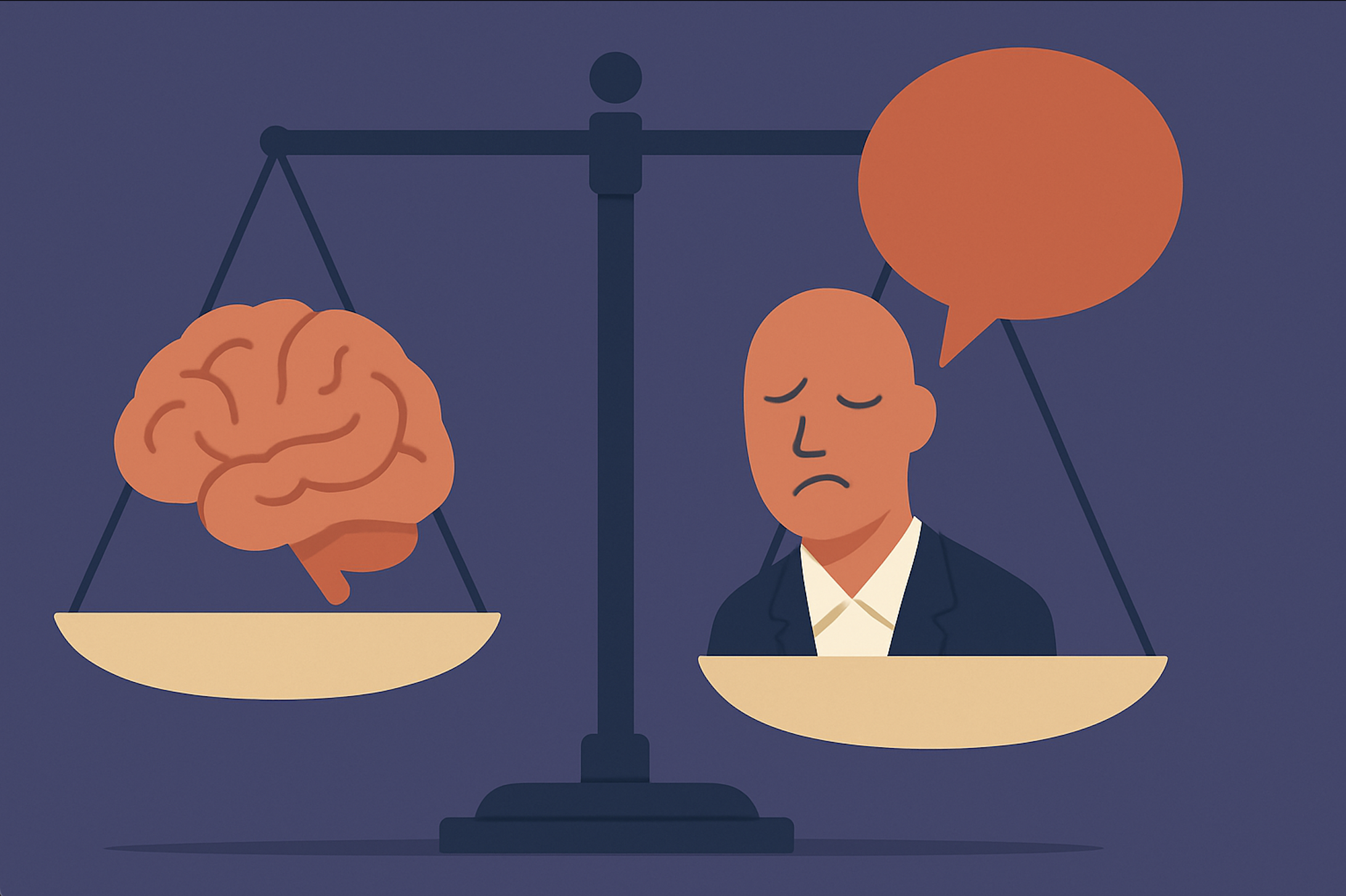
In the pursuit of productivity, efficiency, and performance, many leaders have learned to coach with their heads rather than their hearts. Logic becomes the default language. Data drives the discussion. Metrics outweigh meaning. And emotion, if acknowledged at all, is often treated as a distraction from the real work of development.
But ignoring emotion doesn't make it go away. It sends it underground, where it continues to shape behavior, performance, and engagement without our awareness or direction. The cost of that silence is rarely measured in any quarterly review. It accumulates quietly, and it shows up in the places leaders least expect: in teams that comply but don't commit, in feedback that disappears the moment the meeting ends, in turnover that no retention bonus seems to fix.
Emotion Is Not the Opposite of Logic
There is a persistent misconception in professional environments that emotion and logic are in competition. That to be credible, a leader must be measured. That to be taken seriously, a coach must remain detached. Emotion, in this framing, is a liability: something to manage, minimize, or redirect toward more "productive" territory.
The neuroscience disagrees.
Emotion is not the opposite of logic. It is the context in which logic lives. The brain does not process rational information in a vacuum. It processes it through a lens shaped by how a person feels in the moment, what they believe about themselves, what they fear, and what they need. When emotion is absent from our coaching conversations, we don't get cleaner data or sharper thinking. We get a version of the person that has been edited to fit the room, and we lose access to the very insights that can shape lasting growth.
This is not a philosophical argument for soft leadership. It is a biological one. And it has real consequences for how people receive feedback, respond to challenge, and ultimately change. The leaders who understand this don't abandon structure or standards. They recognize that without the emotional context, even the most thoughtful coaching lands on ground that isn't ready to receive it.
How the Amygdala Shapes Coaching Outcomes
At the center of this conversation is a small, almond-shaped structure called the amygdala. Part of the brain's limbic system, the amygdala is responsible for evaluating threat and safety. It is constantly scanning the environment for signals, asking one fundamental question: is it safe to be here?
When an employee enters a coaching conversation and perceives the interaction as critical, judgmental, or disconnected from their lived experience, the amygdala activates a threat response. This is not a character flaw or a sign of fragility. It is a neurological reflex, older than rational thought, designed to protect the organism from harm.
That threat response has measurable effects on cognitive function. It narrows attention. It reduces openness to new information. It limits the capacity for perspective-taking and self-reflection. In practical terms: even the most thoughtful feedback, delivered into an emotionally unsafe conversation, is unlikely to land. The brain, under perceived threat, is not in a state to receive it.
This is why so many coaching conversations feel productive in the moment but produce little lasting change. The leader covered the right content. The employee nodded in the right places. But the amygdala was still running the show, and the prefrontal cortex, where growth and reflection actually happen, never fully engaged.
What Emotional Avoidance Really Costs
Avoiding emotion in coaching conversations might feel efficient. It keeps things professional. It allows the leader to move through an agenda, address a performance issue, and close the loop. But this short-term efficiency creates long-term debt.
The first debt is trust. When employees consistently leave coaching conversations feeling that only part of them was welcome in the room, they begin to curate themselves. They offer answers rather than honesty. They report progress rather than struggle. They perform the behaviors of a coached employee without doing the interior work that makes coaching valuable. Trust erodes quietly, and by the time a leader notices, it has often been eroding for months.
The second debt is development. Meaningful growth requires self-awareness. Self-awareness requires a degree of vulnerability. And vulnerability is only possible when people feel safe enough to be honest about where they are. When emotion is consistently shut out of the coaching conversation, the conditions for authentic development disappear. Leaders end up coaching a performance rather than a person, and performances can be maintained without any actual change.
The third debt is retention. Disengagement rarely announces itself. It accumulates in small moments: the feedback that didn't feel heard, the conversation that felt scripted, the session that left someone feeling more managed than supported. Over time, those moments compound into a decision to leave. And by the time a team member is actively looking for the exit, the emotional debt has usually been building for a long time.
The Cognitive Toll of Feeling Dismissed
There is a pattern that confuses many leaders. They look at a team member who seems resistant to feedback, who doesn't follow through, who appears to lack accountability, and they diagnose a motivation problem. What they are often looking at is a psychological safety problem.
When people feel emotionally dismissed or misunderstood, the brain responds with elevated cortisol, the body's primary stress hormone. Cortisol, in sustained or repeated doses, impairs the very cognitive functions that coaching depends on: working memory, decision-making, creative thinking, and the integration of new information. What looks like indifference is frequently the downstream effect of a nervous system that has learned this particular conversation isn't safe.
This matters in practical terms. Feedback does not stick when it is delivered into a cortisol-flooded brain. Action plans don't hold when the person who created them felt unheard in the process. The metrics don't move, not because the person doesn't care, but because the conversation never reached the part of them that could translate insight into action.
Leaders who understand this stop trying to fix behavior without first addressing the environment. They recognize that accountability is not something you demand. It is something that becomes possible when the right conditions are in place.
What Emotionally Intelligent Coaching Actually Looks Like
Emotionally intelligent coaching is not therapy. It does not require a leader to process someone's past or serve as a counselor. What it does require is the courage to hold space for the human experience rather than routing around it.
In practice, this means asking questions that go beyond performance data. "How are you really doing right now?" delivered with genuine curiosity and the patience to sit in whatever answer comes back. It means acknowledging that behind every missed deadline or dropped deliverable is a story worth hearing, not to excuse the behavior, but to understand the context in which it happened.
It also means paying attention to what isn't said. Emotion is rarely explicit in professional conversations. It lives in the pause before an answer, in the flatness of tone, in the way someone's posture shifts when a particular topic surfaces. Emotionally intelligent coaches develop the ability to notice these signals and to name them gently, creating an opening for something more honest than the prepared answer.
This is not a skill that comes naturally to most leaders, because most leaders were never coached this way themselves. They learned to coach by replicating what was done to them, which was often a version of performance management dressed as development. Unlearning that pattern takes intention. The return on that investment, however, is significant.
Building Coaching Cultures Where Emotion Has a Seat
Individual coaching conversations are the building blocks of something larger: a coaching culture. And coaching cultures, like all cultures, are shaped by what leaders consistently make room for and what they consistently shut down.
When leaders model emotional awareness in their coaching conversations, when they ask better questions, when they sit in discomfort rather than rushing to fix it, they send a signal that ripples through the organization. People watch what leaders do far more carefully than they listen to what leaders say. A leader who coaches with emotional intelligence creates permission for others to do the same.
The result is not a softer organization. It is a more honest one. Teams that operate in cultures where emotion is allowed to exist, not dominate but exist, communicate more clearly under pressure, surface problems earlier, and recover from setbacks faster. They replace the performance of engagement with something closer to the real thing.
Building that culture starts small. It starts in a single coaching conversation where a leader decides to ask one more question rather than jump to feedback. It starts in the willingness to say, "I want to understand before I respond." It accumulates in the same way emotional debt does, but in the opposite direction.
The Art of Coaching the Person, Not the Performance
Smart leaders understand that coaching is both a science and an art. The science gives us structure: frameworks for feedback, models for conversation, data to anchor our observations. That structure is valuable. It creates clarity and prevents coaching conversations from becoming unmoored.
But the art requires something different. It requires attention, not just to what is being said, but to what is being felt. It requires the willingness to follow a thread when the data points one way but the person in front of you is signaling something else. It requires holding both the performance conversation and the human conversation simultaneously, without letting either disappear.
When coaching integrates both, something shifts. People move from surface-level compliance to deeper commitment. They stop rehearsing change and start experiencing it. They bring more of themselves to the table because they have learned that more of them is welcome.
The hidden cost of ignoring emotion is not just felt in the moment. It compounds, in disengagement, in resistance, in the growing gap between what leaders hope coaching will accomplish and what it actually delivers. When we lead with empathy and curiosity, when we coach the person and not just the performance, we unlock something more durable than compliance: we unlock the conditions for real, lasting change.
If you want your coaching conversations to create meaningful growth, emotion must have a seat at the table. Not as the agenda, but as the context in which everything else becomes possible. Start a conversation with Braintrust about what a NeuroCoaching approach looks like for your leadership team.
