

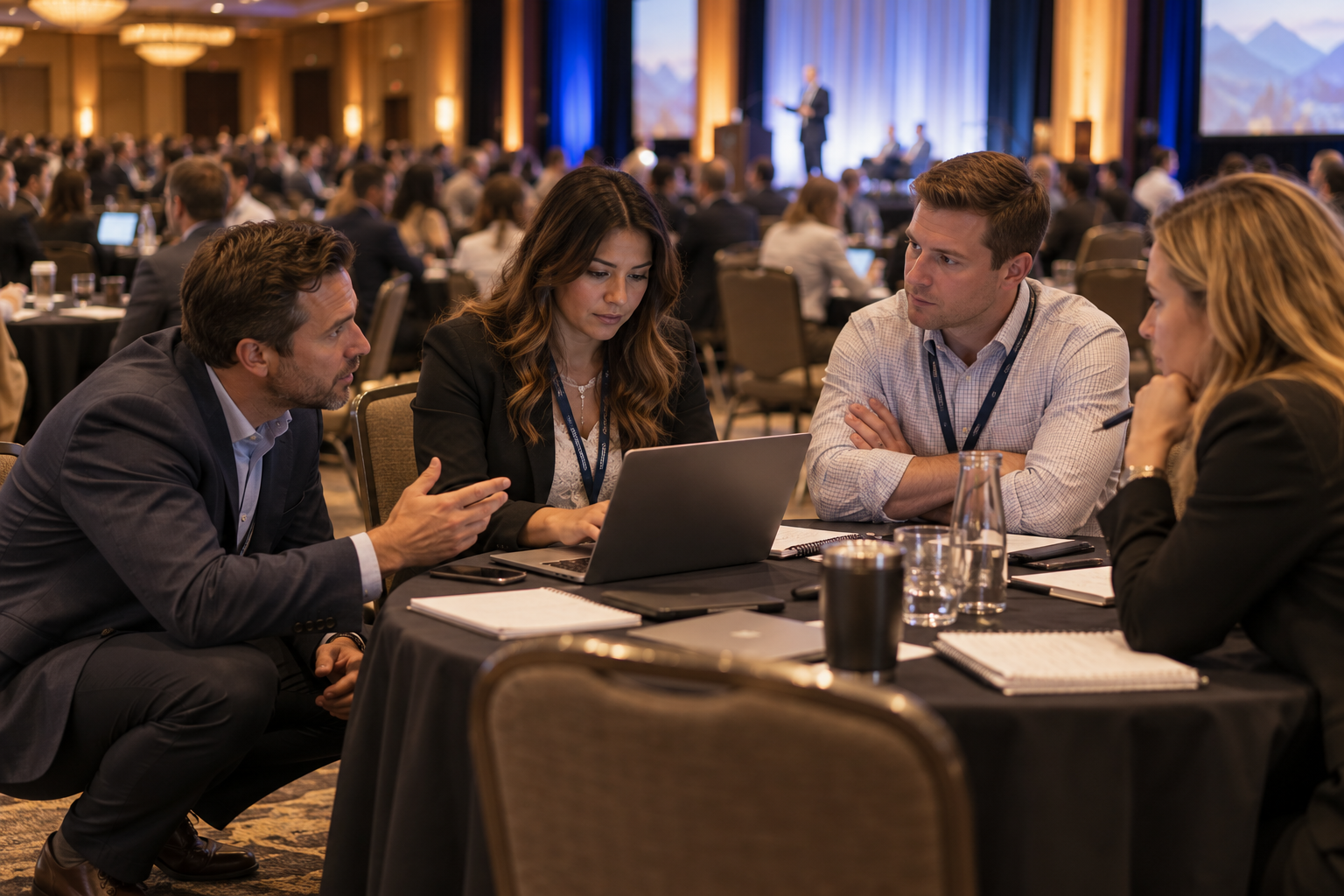
The best sales kickoff ideas aren't the ones that make January feel good. They're the ones that still show up on your reps' calls in March. Most SKO idea lists chase the first goal: a theme, a big keynote, swag, awards, and a packed agenda of product launches. That makes a great two days. It rarely changes what a rep says on a discovery call six weeks later.
The research backs that up. RAIN Group studied 221 sales leaders, managers, enablement professionals and sellers on what separates a high-impact kickoff from the rest. The kickoffs with the strongest impact on seller behavior were more tightly tied to strategy, more interactive, and heavier on realistic practice. The energy still mattered. It just wasn't enough on its own.
So this list uses one filter. Every idea earned its spot because it makes a specific behavior more likely to survive the trip from the ballroom to the pipeline. Two of them draw on research most kickoff planners never see: the fresh start effect, which explains why January is a real psychological landmark and not just a calendar slot, and the way the amygdala decides which moments from a long day get remembered. If you're planning a January or February 2027 kickoff, October is when these decisions get made.
1. Design the Agenda Backward From 2 or 3 Behaviors
Pick the behaviors first, then build the agenda. Most SKO agendas get built forward: every department asks for a slot and somebody writes a theme to tie it together. Reverse it. Decide which two or three things you want reps doing differently on calls by March, and make every session earn its place against that list.
Good target behaviors are observable. "Be more consultative" isn't one. "Quantify the cost of the problem before the demo" is. So is "Confirm the economic buyer's success metric on the second call." If a manager can't hear it on a recording, it's a theme, not a behavior. RAIN Group calls the idea that ties it together a golden thread: one strategic priority that runs through every session.
What a backward-built sales kickoff agenda looks like
Here's a sample two-day agenda built around two target behaviors. The structure is what matters.
| Block | Session | Behavior It Serves |
|---|---|---|
| Day 1, morning | Leadership opener: this year's strategy and the 2 behaviors that execute it | Both |
| Day 1, late morning | The felt moment: a customer story or keynote built around behavior 1 | Behavior 1 |
| Day 1, afternoon | Live practice on real deals, run by frontline managers | Behavior 1 |
| Day 1, evening | Recognition: awards for last year's best examples of both behaviors | Both |
| Day 2, morning | Product and strategy updates, framed by the buyer problem each one solves | Behavior 2 |
| Day 2, midday | Certification on one talk track, scored by managers | Behavior 2 |
| Day 2, afternoon | Manager-led team planning: every rep picks a live deal to apply both behaviors in week one | Both |
| After the event | 30, 60 and 90-day reinforcement, already on the calendar | Both |
Notice what's missing: a panel with no point of view and four back-to-back product sessions.
2. Send Pre-Work Built on Real Calls, Not Reading
Make reps bring their own material. Standard SKO pre-work is a reading assignment or an online module nobody finishes. Swap it for two things: one recorded call the rep thinks went sideways, and one live deal they need to move in Q1.
This does two jobs. It shows enablement where the target behaviors actually break down, so practice aims at real gaps. And every rep walks in with a deal the kickoff can work on. Practicing on your own pipeline feels different from practicing on a fictional account called Acme.
Keep it short. If pre-work takes more than an hour, expect a lot of the room to skip it.
3. Use the January Timing on Purpose
Treat the kickoff as a new chapter, not just a calendar slot. Most SKOs land in January because that's when the fiscal year starts. That timing is more useful than it looks.
Hengchen Dai, Katherine Milkman and Jason Riis named it the fresh start effect (Management Science, 2014). People are more likely to start pursuing goals right after temporal landmarks, like a new week, a new month or a new year. In their data, Google searches for "diet" ran 82.1% above baseline at the start of a new year. Their explanation is that landmarks open a new mental accounting period. Last year's misses get filed in a previous chapter, and people step back and look at the bigger picture.
A follow-up study from the same team (Psychological Science, 2015) found that landmarks motivate more when they're framed as new beginnings. That's your job at the kickoff. Say it out loud: last year's habits belong to last year. Then start the new behaviors in week one, while the landmark is still fresh. A landmark opens a window. It doesn't hold it open, which is why idea 10 matters so much.
4. Build One Felt Moment and Tie It to the Behavior
Use emotion to carry the one thing you want remembered. Every kickoff has a peak: a keynote that lands, or a customer who tells the room what your team did for them. Most planners treat that moment as entertainment. It's your best shot at memory.
James McGaugh's research on emotional memory (Annual Review of Neuroscience, 2004) shows why. When an experience is emotionally arousing, stress hormones and neurotransmitters act through the amygdala to strengthen how that memory gets consolidated elsewhere in the brain. In human imaging studies, how strongly the amygdala activates during an emotional experience correlates closely with how well people recall it later. The boost is selective. It goes to what felt significant, not to the slide deck that ran before lunch.
That's the problem with most SKO keynotes. They create a strong emotional moment that isn't connected to anything reps are supposed to do. So brief your speaker on the behavior. Put a customer on stage who can describe what it felt like when a rep did that exact thing well. Then go straight into practice while the room still feels it. Jeff Bloomfield, Braintrust's founder and the author of NeuroSelling, built the NeuroSelling methodology around how the brain actually makes decisions, and emotion sits at the center of that process. Your reps are an audience too.
5. Swap Product Marathons for Live Practice on Real Deals
Cut product time and give it to practice. The most familiar SKO complaint is the feature marathon: hour after hour of launch slides. Reps need to know what's new. They don't need to hear all of it at the kickoff, the one window when the whole team is in a room with their managers.
Use the deals reps brought in their pre-work. Pair reps up, have one play the buyer on the other's real opportunity, and have a manager score it against the target behavior. Run it twice. The second round is where you start hearing the behavior.
Move most product content into short recordings. Keep live product time for questions only a live room can answer.
6. Certify on One Talk Track, Not Ten
Narrow certification to the conversation that matters most. Plenty of SKOs end with reps "certified" on the pitch, pricing, competitive positioning and three personas. Nobody is good at ten things after two days. They're vaguely familiar with ten things.
Pick the one conversation that carries the most revenue risk this year. It's usually the one your target behaviors live in. Build a simple rubric. Have every rep deliver it live or on video to a manager who scores it. Reps who don't pass get coached and try again in two weeks.
You'll also know exactly who can do the behavior on day two. That's your baseline for March.
7. Run Manager-Led Breakouts So the Follow-Up Owner Is in the Room
Put frontline managers in charge of practice, not outside facilitators. Here's the gap most kickoffs leave open. The people who teach the content go home on Friday. The people responsible for follow-up, the frontline managers, sat in the back row answering email.
Flip that. Have managers run breakouts for their own teams, and prep them a week ahead with the behaviors, the rubric, and a short guide on giving feedback during practice. That means the manager heard every rep try the behavior, knows who struggled, and owns the coaching conversation in week two. If your managers aren't ready to coach at that level, start there. Helping managers develop sellers in real one-on-one conversations is the focus of NeuroCoaching for sales managers.
8. Cut the Session Count Until There's Room to Practice
Run fewer sessions, and make them longer. A packed agenda feels like a responsible use of the travel budget. It isn't. Every added session competes for the same limited attention, and reps leave with a blur instead of two behaviors.
Set a hard rule: every session has to map to a target behavior or a must-know business update. Anything else becomes a recording, a one-pager or a Q1 team meeting. Give the freed-up time to practice, debriefs and white space. Reps trading deal advice in the hallway isn't wasted time. It's the kickoff working.
9. Give Awards for the Behavior, Not Just the Number
Recognize how the deal was won, not only how big it was. Every SKO has awards, and most go to the biggest number: President's Club, top new logo, quota leader. Keep those. Then add awards tied directly to the behaviors you're asking for this year.
If the behavior is quantifying the cost of the problem before the demo, give an award for the best example of it from last year, and play the clip. Recognition tells the room what the company actually values. A real clip shows reps what good sounds like.
10. Plan the 30/60/90-Day Reinforcement Before the Event
Build the follow-up before you book the venue. The kickoff is the starting gun, not the race. Most of the behavior change happens, or doesn't, in the 90 days after reps fly home. We've written about why sales training works better as a system than an event, and the SKO is the most expensive version of that problem.
Put three checkpoints on the calendar now. At 30 days, managers review one recorded call per rep against the certification rubric. At 60 days, run a short live booster on whatever the reviews showed was slipping. At 90 days, compare call behavior to the certification baseline and report it next to pipeline. Short, frequent practice fills the gaps in between. That's why Braintrust runs much of its reinforcement through short AI practice reps inside the normal workflow, not through one more workshop.
Decide how you'll measure it, too. RAIN Group found that organizations with less effective kickoffs were 3.3 times more likely not to measure SKO success at all. Attendance and satisfaction scores tell you people showed up and liked it. Behavior on recorded calls tells you whether it worked. Here's more on how to measure whether training changed field behavior.
Sales Kickoff Best Practices: Quick Reference
Use this as a planning checklist for your next SKO. Each row maps to one idea above.
| Idea | Why It Matters | What to Do |
|---|---|---|
| Design the agenda backward | Forward-built agendas fill up with sessions that change nothing | Pick 2 or 3 observable behaviors and cut any session that doesn't serve one |
| Pre-work built on real calls | Practice aims at real gaps and real deals instead of assumed ones | Ask each rep for one recorded call and one live Q1 deal |
| Use the January timing | New-year landmarks raise motivation to start new goals (fresh start effect) | Frame the event as a new chapter and start the behaviors in week one |
| One felt moment | Emotional arousal strengthens memory for what felt significant | Tie the keynote to behavior 1, then practice it right after |
| Practice on real deals | High-impact SKOs are 2.8x more likely to include extensive realistic role-play | Move product content to recordings and practice in pairs |
| Certify on one talk track | Ten certifications produce familiarity, not skill | Score one high-stakes conversation with a rubric and retest in two weeks |
| Manager-led breakouts | The follow-up owner needs to hear every rep try the behavior | Prep managers a week ahead to run practice for their own teams |
| Cut the session count | More sessions split limited attention across more content | Map every session to a behavior or a must-know update |
| Awards for the behavior | Recognition signals what the company actually values | Add awards for last year's best examples and play the clips |
| Plan reinforcement first | Behavior change happens in the 90 days after the event | Schedule 30, 60 and 90-day call reviews against the baseline |
Putting It Together
Look at the list as a whole and it splits into three phases. Before the event, you choose the behaviors, collect real calls, prep managers and schedule reinforcement. During the event, you use the January landmark, create one felt moment, and spend most of the time practicing on real deals. After the event, managers coach to the certification rubric and you measure behavior on calls, not smiles on surveys.
Most sales kickoff ideas live entirely in the middle phase. That's why so many SKOs are memorable and so few are effective. The event matters. It just isn't where the behavior change happens.
Here's a simple test for your 2027 agenda. Pick any session and ask what a rep will do differently on a call in March because of it. If nobody can answer, cut it or fix it.
If you're planning a kickoff and want a second set of eyes on whether it'll still show up in March, it's worth a conversation. Start a Conversation with our team.
