

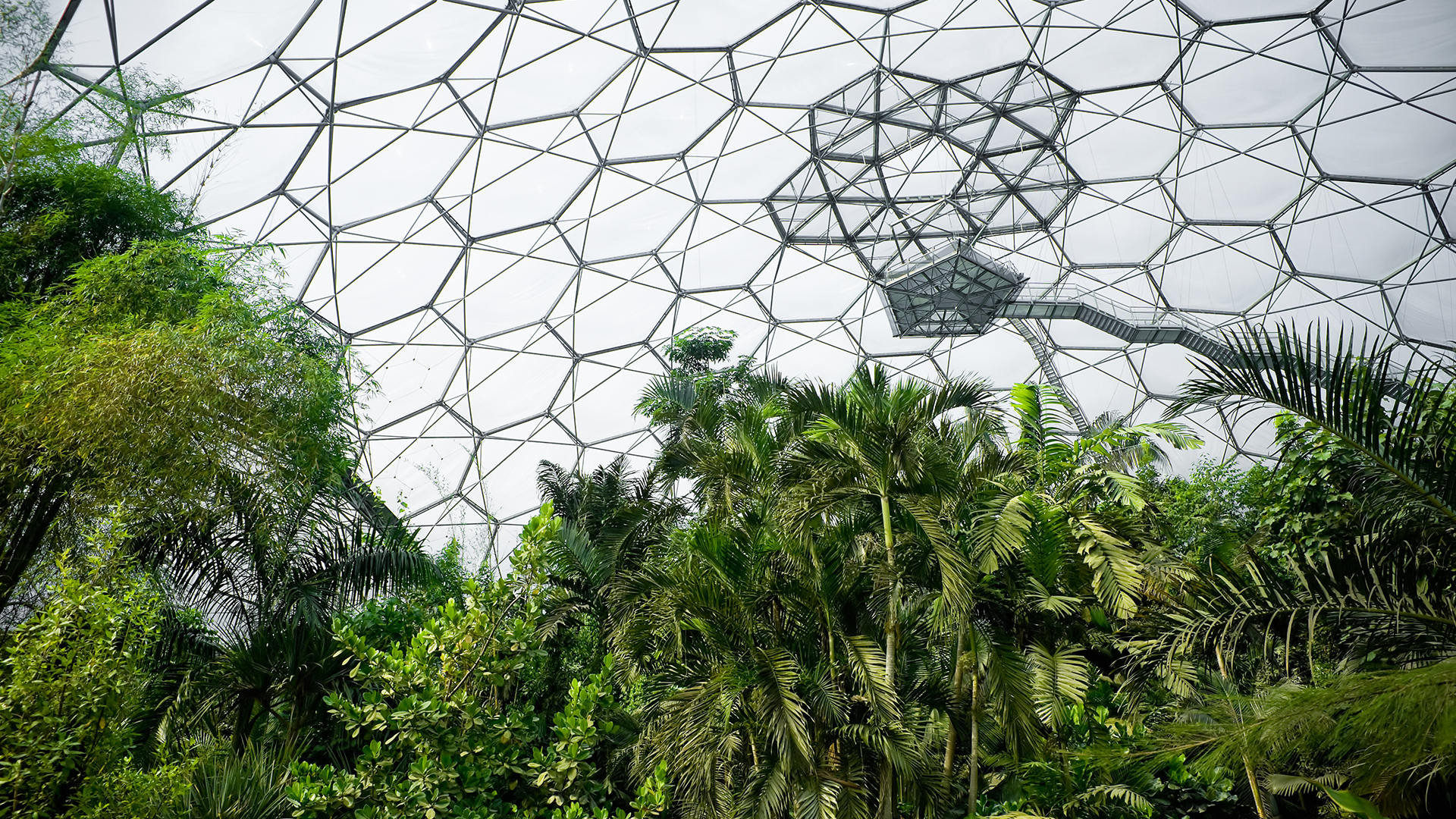
Between 1987 and 1991, scientists built a research facility called Biosphere 2 in Arizona. The primary aim was to study the elements of nature's ecosystems in a closed and controlled environment, to understand their dynamics and see if we could replicate those ecosystems in space. The experiment yielded tremendous data, but one of the most interesting learnings was what happened to the trees.
When Wind Becomes a Teacher
To the surprise of everyone, the Biosphere 2 trees grew much faster than in nature. However, they fell over before fully maturing. Upon further investigation, researchers concluded that this occurred because their root systems were far weaker than those of trees growing outdoors. The reason? The scientists had not accounted for the wind. It is the repeated, gentle push and pull of the wind that promotes a deeper, wider, and more grounded root system in trees growing in the wild.
Trees need resistance to grow strong and healthy. Remove the resistance and you get rapid but hollow growth, a plant that looks mature from the outside and collapses under its own weight.
Resistance Is the Mechanism of Growth
Most of us relate to this concept most easily through athletics. The harder you train your body, the stronger it gets (within appropriate limits). The more you practice a specific sport or discipline, the better you become at the skills that discipline demands. Resistance is not an obstacle to performance. It is the precondition for it.
There is a critical difference, though, between the Biosphere tree and the athlete. With sports, we understand that we can intentionally choose to do the hard or uncomfortable work. That choice is a precursor to action and, ultimately, to achieving a desired outcome. The brain does not make this easy. Our brains are hardwired to avoid actual, perceived, or potential discomfort and pain. When we decide to act intentionally and place our bodies and minds into uncomfortable situations to pursue a goal, we call that capacity willpower.
What Willpower Actually Is
Willpower is the mental skill to do, or not do, what is required to achieve a given goal. Whether it involves giving a presentation you would rather skip, learning new sales training concepts that seem difficult to implement, or working through a difficult client relationship, activating willpower is rooted in both psychology and biology.
For sales professionals and the leaders who develop them, this is not an abstract concept. The ability to push through the friction of learning, to practice uncomfortable skills, and to repeatedly attempt new behaviors is what separates reps who absorb training from those who don't. Willpower is a performance variable, and it turns out it can be trained.
The Brain Is More Like a Muscle Than We Thought
What if parts of our brain are structured more like muscle tissue than a fixed, finite grouping of neurons? We know that human brain development begins in the womb, continues after birth, and typically completes by the late 20s or early 30s. But scientists have now discovered that neurogenesis, the process by which the brain creates new brain cells, can also occur after the brain reaches full maturity.
There are even regions of the brain capable of building and rebuilding damaged areas when properly activated. Studies around the hippocampus and its function in memory, for example, have demonstrated the brain's ability to grow that region and improve memory with the right stimulation, even in elderly populations. The brain is not a static organ. It responds to the demands placed on it.
Meet the Anterior Mid-Cingulate Cortex
Researchers have recently identified another region of the brain with this same capacity for growth: the anterior mid-cingulate cortex (aMCC). Located in the prefrontal cortex, the aMCC contributes to willpower by giving the brain the ability to do things it does not want to do. In practical terms, it helps override our instinctual impulse to seek pleasure and avoid pain.
Using functional MRI scans, researchers have observed a direct relationship between behavior and structure: the more an individual chooses to do something they dislike or want to avoid, the more this region grows in size. The key phrase is doing something you do not want or like to do. That is the stimulus.
The One Rule That Makes It Work
Here is the critical nuance. If you love hitting the gym and working hard, that will not stimulate this region. If you genuinely enjoy the professional growth aspects of sales training, it will not grow the aMCC either. The stimulus must be a real mental struggle that you override and push through.
Someone who deeply fears water and decides to submerge their head in a pool is growing the aMCC. A rep who hates waking up early but sets a 5 AM alarm to review sales training before a call is growing the aMCC. The discomfort must be real. The override must be deliberate.
Researchers have also noted that, like a muscle, this region will grow when stimulated and shrink when not. Studies have found the aMCC to be noticeably smaller in sedentary, less active individuals and measurably larger in those who are consistently active and engaged in deliberate challenge.
What This Means for Sales Training
For sales leaders and enablement professionals, the implications are direct. When a rep resists a new framework, pushes back on role-play practice, or avoids the uncomfortable conversations your training is designed to build, that resistance is not just a training problem. It is a willpower problem, and willpower responds to the same principles as physical conditioning.
Reps who consistently push through the discomfort of learning new communication habits are, quite literally, building the neural infrastructure to sustain that behavior over time. Those who consistently avoid the friction are allowing that infrastructure to atrophy. This is why training that challenges reps beyond their comfort zone tends to produce more durable behavior change than training designed to minimize friction. The wind is the mechanism.
Seek the Winds in Your Own Life
If you want to increase your willpower, you need to seek out and overcome the winds of life. By consistently choosing to do things you do not enjoy but know will serve you in the long term, you build the neural root system that holds when pressure arrives. The Biosphere 2 trees had every advantage except the one that mattered. Do not train in a windless room.
The same principle applies to every sales rep sitting in a training session, every leader facilitating a difficult coaching conversation, and every enablement professional designing a program. Build the wind in. It is not optional. It is the mechanism of growth.
Worth a conversation about how Braintrust builds that kind of deliberate challenge into sales team development? Start a conversation with our team.
References
The Tenacious Brain: Cortex. 2020 Feb; 123: 12-29.
How to Build Willpower (YouTube): Interview with David Goggins and Dr. Andrew Huberman
What Is Neurogenesis: Kendra Cherry, Nov 1, 2023, Verywell Mind
