

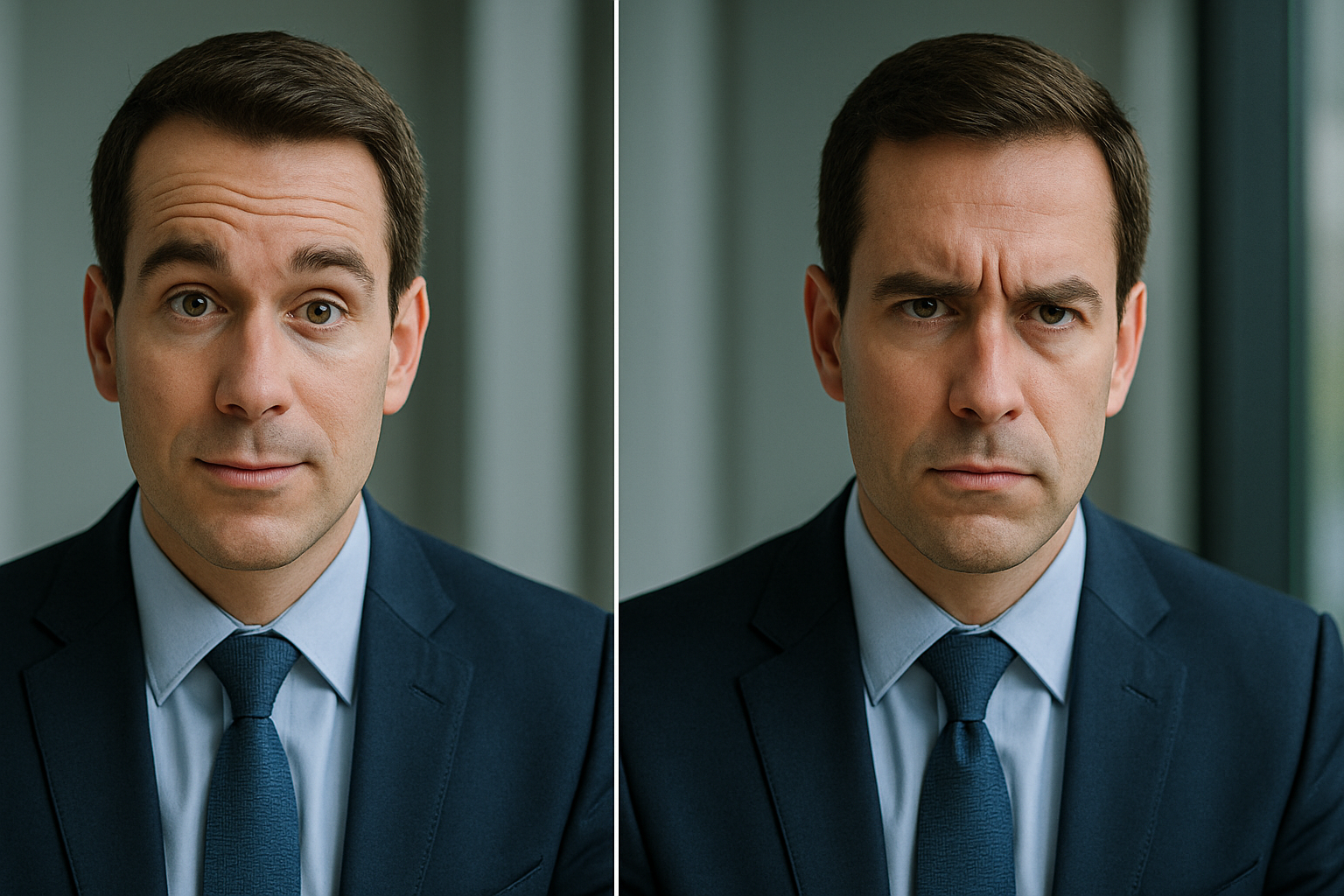
You've been there before. You're delivering your pitch, explaining your value proposition, and on the surface, the buyer seems engaged. They're nodding. Smiling, even. Saying all the right words. But something feels off. Something unsaid.
A slight tightening of the mouth. A brief furrowing of the brow. A quick downward glance. It's subtle, maybe even unconscious, but your gut registers it. The question is, do you trust it? And more importantly, do you know how to respond to it?
These subtle facial shifts are called microexpressions: involuntary, split-second facial movements that reveal a person's true emotional state. Whether your buyer intends to show it or not, their face leaks information their words may not.
Sales professionals who can spot these cues have a serious competitive advantage. They can pivot faster, ask better questions, and tailor their message in real time, because they're selling to what's really going on, not just what's being said.
What Are Microexpressions?
Microexpressions are brief, involuntary facial expressions that occur when someone feels an emotion but tries to conceal it, or is not consciously aware of it. These expressions flash across the face in as little as 1/25th to 1/5th of a second.
Discovered and researched extensively by psychologist Dr. Paul Ekman, microexpressions are universal. Across cultures, genders, and backgrounds, humans display the same set of microexpressions for the seven basic emotions: happiness, sadness, anger, fear, disgust, surprise, and contempt.
These fleeting expressions are rooted in the limbic system, the emotional center of the brain, and are almost impossible to suppress fully because they occur before conscious control kicks in.
In sales, microexpressions can signal unspoken objections, confusion, skepticism, or, on the positive side, interest, excitement, or agreement. The key is learning to recognize them and respond appropriately.
The Neuroscience of Microexpressions in Decision-Making
When people make decisions, especially high-stakes business decisions, their emotional brain processes the information milliseconds faster than the logical brain.
This is why buyers can say, "I need to think about it," when in reality their emotional system has already decided. Microexpressions are the tells. They expose this emotional processing as it happens.
Ignoring microexpressions means flying blind to what the buyer's brain is really signaling. Reading them means seeing the decision process unfold in real time, before it becomes a stalled deal or a silent "no."
What Salespeople Typically Miss
Most sellers over-index on words and miss nonverbal cues entirely, especially on virtual calls where distractions are high and video quality can mask subtle shifts.
It's common for sellers to miss signals of confusion because the buyer is smiling politely. They fail to notice a flash of skepticism when pricing is mentioned. They overestimate interest because the buyer nods reflexively, not meaningfully.
The consequence is a pitch that continues without adjustment, leaving objections unspoken, concerns unaddressed, and deals stalled without clear reason.
Common Microexpressions to Watch for in Sales
Not every microexpression carries equal weight in a sales conversation. These are the six most important to train your attention on:
Furrowed Brow (Confusion, Concern): Appears when a buyer doesn't fully understand something or has unresolved questions. This is your signal to pause and check for clarity.
Lip Press (Discomfort, Holding Back): A brief pressing of the lips often signals internal disagreement, resistance, or an objection they're not verbalizing. Time to surface what's unsaid.
Nose Wrinkle (Disgust or Aversion): Can appear when the buyer dislikes an idea, a feature, or how something is framed. Pay attention if this shows up when discussing pricing or product fit.
Eye Flash (Surprise): Eyebrows quickly raise. Positive if paired with a smile, negative if followed by a frown. It signals that something unexpected, good or bad, just landed.
Contempt (One-Sided Mouth Raise): A subtle smirk on one side can indicate skepticism or dismissal. It often shows when a buyer doesn't believe what's being said.
Micro-Smile (Pleasure, Agreement): Appears when something resonates. This is your signal that you've hit on a genuine value point worth staying on.
How to Respond in Real Time
Recognizing microexpressions is only half the skill. What matters more is how you respond. The goal isn't to confront the emotion directly but to surface it gently with curiosity.
If you notice a flash of skepticism when you mention pricing, you don't say, "I saw your face, what was that?" Instead, try: "I'm getting the sense that this may not be aligning perfectly yet. Can we pause there, what's on your mind?"
Or if a buyer furrows their brow during a technical explanation: "I may have skipped a step there. Would it be helpful if I unpacked that a bit further?"
This gives the buyer a safe invitation to verbalize what their face already revealed. It lowers the social threat, keeps the conversation collaborative, and allows you to address objections before they grow silent and fatal to the deal.
Microexpressions in Virtual Sales
Virtual selling adds complexity. Poor lighting, camera angles, and video compression can obscure cues. But microexpressions are still detectable, especially around the eyes and mouth.
On video, keep your buyer's face as large as practical on your screen. Pay attention to micro-pauses, shifts in tone, or subtle facial contractions. If something feels off, it probably is, even if it's just for a fraction of a second.
The Ethical Use of Microexpression Reading
This isn't about manipulation. It's about attunement. Buyers often don't fully know how to articulate their concerns in the moment. When sellers become more emotionally attuned, they foster trust.
By noticing discomfort, confusion, or excitement and responding with empathy and curiosity, you're not pushing harder. You're serving better.
The Bottom Line: Sell to the Whole Brain, Not Just the Words
In every sales conversation, there are two dialogues happening. One is verbal. The other is emotional, nonverbal, and often subconscious.
Sales professionals who master reading microexpressions unlock the ability to tailor their pitch in real time, deepen trust faster, and surface unspoken objections before they stall the deal.
Selling isn't just about saying the right thing. It's about seeing the right thing, the thing the buyer's face tells you before their words do. This is the next level of consultative, emotionally intelligent selling.
If you're ready to explore what training your team on the full neuroscience of buyer communication looks like in practice, start a conversation with Braintrust.
