

You are outstanding. That sentence may land as strange, maybe even suspicious, coming from someone who doesn't know you. And if your first instinct is to push back on it, that instinct is fair. But here is what makes the claim worth examining: it doesn't depend on knowing you personally. It depends on something the neuroscience of belief and performance has now documented thoroughly. You carry a set of experiences, perspectives, and patterns that exist nowhere else on earth. What you do with that combination, especially in how you see yourself and the people around you, turns out to matter more than most of us have been told.
Your Uniqueness Is Not a Cliché
The claim that you are "unique" gets dismissed quickly because it gets said cheaply. It shows up on motivational posters and graduation speeches until the word loses its weight entirely. But pull it out of that context and look at what it actually means. You have a set of experiences that are yours alone. They have shaped your personality, formed your opinions, colored your worldview, and built the lens through which you read every situation you walk into.
No one shares that exact combination. The events that made you cautious, the people who made you curious, the failures that recalibrated you, the moments that quietly shifted everything: none of that happened the same way to anyone else. Your story is not just yours in a poetic sense. It is yours in a structural, literal sense. And it is the starting point for understanding why what you believe about yourself, and what others believe about you, produces results you can actually measure.
Three Reactions, and What They Reveal
Reading that opening, one of three things probably landed in your mind. The first: "That's a nice thing to hear. I don't get reminded of that enough." The second: "What is he selling?" The third: "I appreciate the enthusiasm, but I'm nothing special." All three reactions are reasonable. All three also reveal something about the relationship you carry with your own sense of potential.
That relationship, it turns out, is not just philosophical. It is measurable. It shows up in how you approach hard problems, how you respond after a setback, and how you perform in high-stakes situations where the gap between "I can do this" and "I probably can't" determines what you actually do next. The distance between those two internal stances is not a matter of personality. It is, in large part, a matter of practice.
What Zig Ziglar Knew Before the Science Confirmed It
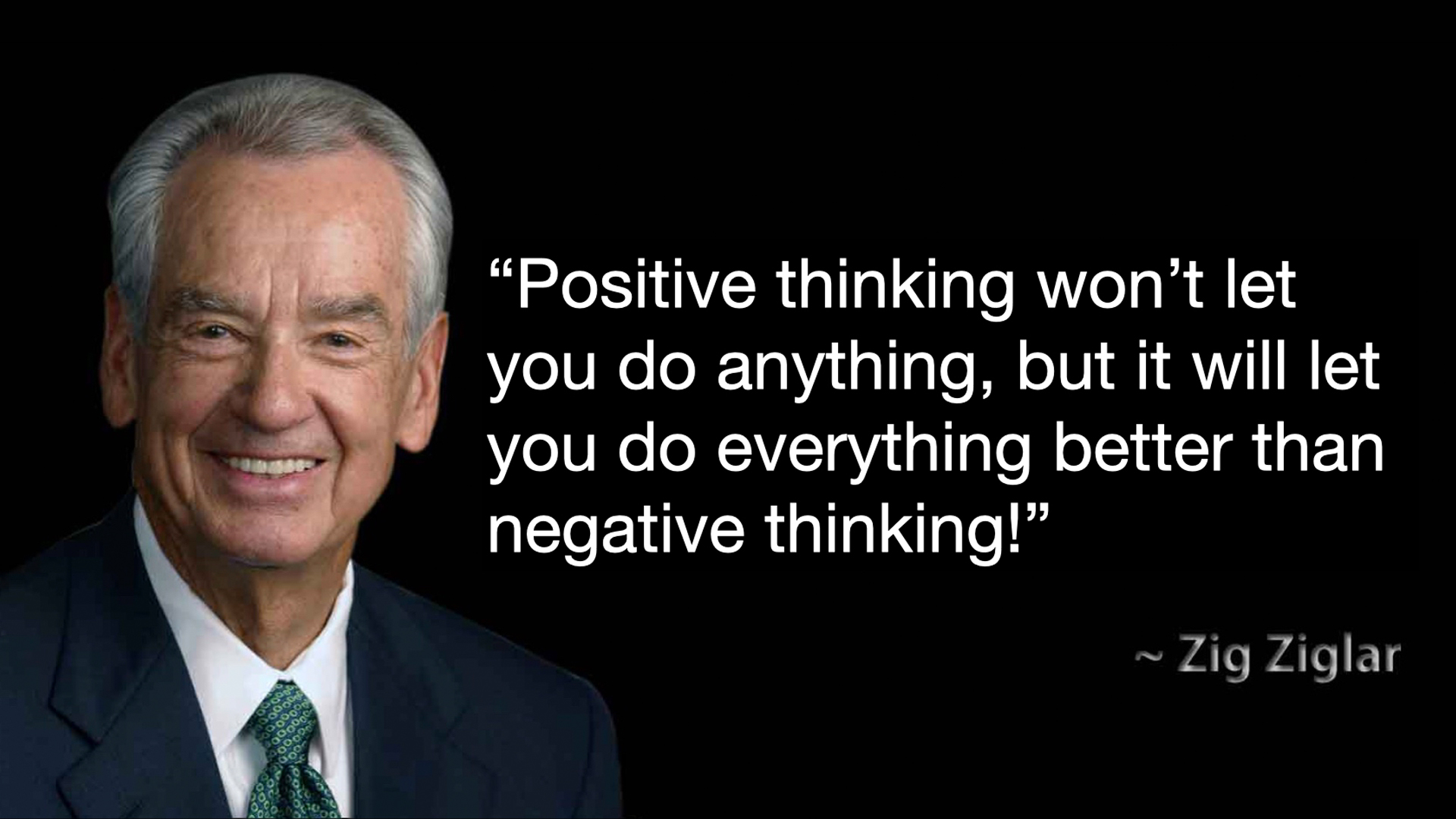
Zig Ziglar spent decades in front of audiences, telling people that how they saw themselves would determine who they became. He put it plainly: "Positive thinking won't let you do anything, but it will let you do everything better than negative thinking." He couldn't have known the full neurological mechanisms behind that observation. But he knew the pattern. He had watched it repeat across thousands of people in thousands of contexts. He built an entire framework around what he called Positive Self Talk: the deliberate practice of constructing how you speak to yourself about your potential, your capacity, and your future.
His son Tom, who now runs Ziglar Inc., joined us on the Driving Change Podcast to talk about what it was like growing up as "the proud son of Zig Ziglar." One of the things Tom returned to was this: his father didn't treat affirmation as a soft skill or a feel-good exercise. He treated it as a performance variable. And he called it "Truth Telling in Advance." Not wishful thinking. Not manufactured confidence. Telling yourself the truth about who you are capable of becoming before the outcome confirms it.
What Zig didn't have was the imaging data, the longitudinal studies, or the replicated trials. What he had was a pattern so consistent across audiences that he built a philosophy around it. The neuroscience that has accumulated in the decades since has filled in the mechanisms behind what he observed.
The Neuroscience Behind "Truth Telling in Advance"
Research on self-affirmation has produced a substantial and growing body of evidence connecting how individuals perceive their own potential to how they actually perform. The correlation is not trivial. Studies show that when people hold an accurate, positive view of their own capacity, they engage more persistently with difficult tasks, recover more quickly from setbacks, and approach high-stakes situations with the physiological composure that allows their actual ability to show up rather than be crowded out by doubt.
Part of this is driven by what happens neurologically when self-perception shifts. The prefrontal cortex, which governs executive function, deliberate decision-making, and complex problem-solving, operates more effectively when the limbic system is not running a background threat-response directed at the self. In practical terms: when you believe you are capable, your brain allocates more cognitive resource to actually performing. When you believe you are not, a portion of that bandwidth goes to managing the internal noise of inadequacy.
"Fake it till you make it" has always been a shallow read of what Zig actually meant. What the research supports is something more precise. Accurate, future-oriented self-belief activates the neural pathways associated with motivated, approach-oriented behavior. It is not pretending. It is priming.
The Study That Made Belief a Data Point
In the 1960s, Harvard psychologist Robert Rosenthal designed an experiment that would become one of the most cited in all of educational psychology. He administered a "cognitive ability test" to students across 18 classrooms, ranging from kindergarten through fifth grade. The test was framed to teachers as a measure of intellectual potential, designed to identify which students were on the verge of significant learning breakthroughs.
Once scoring was complete, Rosenthal shared results with each teacher and told them that approximately 20 percent of their students had shown the markers of exceptional intellectual growth in the coming year. He called these students "bloomers." Naturally, the teachers responded as any invested educator would: they gave those students more attention, held higher expectations, offered more engaged feedback, and believed, genuinely, that these particular kids were capable of something more.
One year later, Rosenthal retested the students. The "bloomers" had, in fact, bloomed. Their IQ scores had risen at significantly higher rates than their classmates. Two years later, they were still outperforming peers who had started from the same baseline.
Here is what makes the study remarkable: the students labeled as "bloomers" had not scored higher on the original test. Rosenthal had selected them at random. There were no actual cognitive markers of superior potential. There was only the teacher's belief that the potential was there. And that belief, held consistently by someone in a position of influence, created the performance it expected.
From Classrooms to Conference Rooms
Researcher Brian McNatt wanted to know whether the Pygmalion effect, as Rosenthal's finding came to be called, extended beyond educational settings into organizational life. He conducted a meta-analysis of 17 different studies involving nearly 3,000 employees across a range of industries and company types. The pattern held.
When managers were led to believe that certain employees had high potential, those employees performed at elevated levels. This was not explained by pre-existing skill differences. It was explained by the nature of the manager-employee relationship and the expectations that flowed through it. Managers who believed in their people spent more time developing them, gave more specific and constructive feedback, assigned more challenging work, and communicated a confidence that the employee absorbed and internalized.
The mechanism is not mysterious. When a person in authority treats you as capable, your brain registers something fundamentally different than when they treat you as a fixed quantity. The neural encoding of "I am someone worth investing in" produces different behavior than "I am someone to be managed." And that behavioral difference compounds over time, creating the performance gap that the original belief assumed was already there.
This is why the belief you carry about the people around you is not a private matter. It is a performance variable. It shows up in how you structure conversations, what you choose to delegate, what challenges you offer, and what you assume someone can handle. Your beliefs about people are expressed in a hundred small behaviors every day. And those behaviors, received by the people on the other end, shape how they see themselves.
Two Takeaways Worth Keeping
After the research, the examples, and the mechanisms, two conclusions remain that are simple enough to be practical.
The first: if you want the best out of the people around you, orient toward their potential rather than their current performance. Not a manufactured orientation. Not empty praise that lands hollow. A genuine, honest focus on what someone is capable of becoming, held consistently across the interactions that make up your working relationship. That orientation expresses itself in how you speak to people, what you ask of them, and whether you stay invested when it gets hard. It does not require certainty. It requires direction.
The second: if you want to become the best version of yourself, you cannot fully outsource that belief to other people. External affirmation helps. It is not nothing. But the version of you that performs consistently, adapts under pressure, and grows through difficulty is the version that has developed an accurate, forward-looking view of what you are capable of. Zig called it Truth Telling in Advance. The research calls it self-efficacy. The pathway, in either case, runs through self-perception.
The Universal Foundation Beneath All of It
Here is what ties this together. Your experiences are unique, and that makes them genuinely special. No one has walked the exact path you have walked. The specific combination of what shaped you, challenged you, and changed you belongs to no one else. But your feelings, your full range of joy and fear, excitement and disappointment, connection and loneliness, those are not unique at all. Every person you will ever meet has felt exactly what you have felt, even when the circumstances were entirely different.
Inside that combination, you have something rare. A single, unrepeatable personality. A one-of-a-kind story. A set of circumstances no one else shares. And at the same time, the full range of human experience that allows you to sit across from anyone on earth and understand them at the level that actually matters. To share something real. To build trust. To make a connection that holds.
That is not a small thing. And if you want to lead more effectively, develop the people around you, or simply show up as more of who you actually are, start here: you are not a fixed asset. Neither is anyone on your team.
If you are working to build leaders who see that potential in themselves and in the people they lead, start a conversation with the Braintrust team. That is exactly the kind of work we do.
