

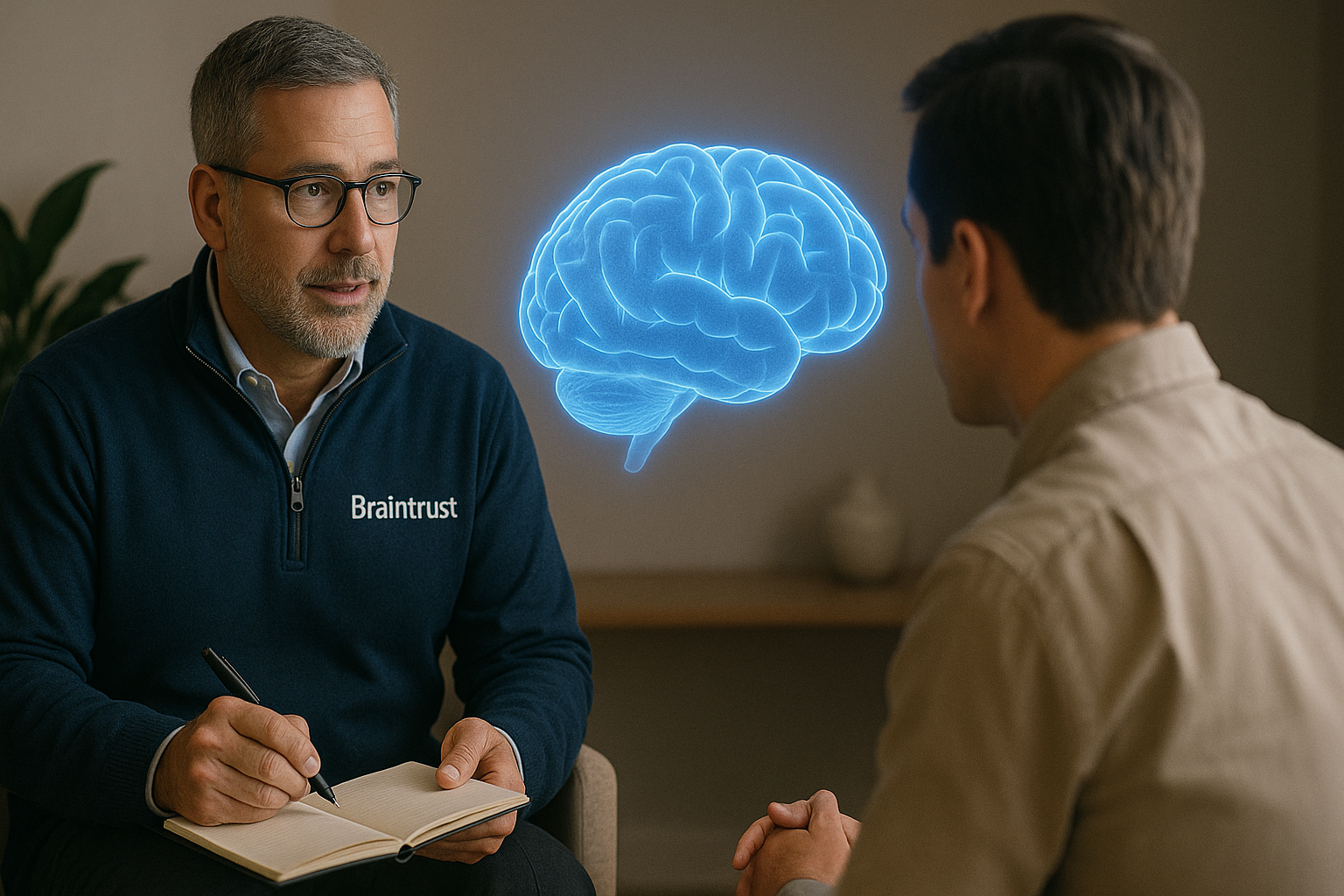
It was a Wednesday morning in Chicago, in a quiet suburban office just off the highway. I had flown in the night before, grabbed a protein bar from the hotel lobby, and walked into a training room where 50 seasoned leaders sat in folding chairs with their arms crossed and their skepticism fully activated, seemingly uninterested in behavioral change.
We were there to talk about coaching. Specifically, NeuroCoaching, a framework my team and I developed that integrates neuroscience, behavioral psychology, and practical communication tools. But what they really wanted to know was: "Will this actually change anything?"
That's the question we all face in coaching. Not, "Can I run a good session?" or "Will they like the training?" The real question is: How do we create change that actually sticks? That's where NeuroAnchoring comes in.
Why Most Coaching Change Doesn't Stick
Most coaching programs fail not because of bad content, but because of missing infrastructure. Leaders leave a session with insight, intention, and energy. Then Monday morning arrives. The inbox floods. A difficult conversation derails the day. And every behavior that felt so clear in the training room slips back into the familiar default.
The brain isn't resisting change out of stubbornness. It's doing exactly what it was designed to do: conserve energy by returning to well-worn neural pathways. To override that pull, you need something stronger than a slide deck and a workbook. You need a neural anchor.
What Is NeuroAnchoring?
At its core, NeuroAnchoring is the process of intentionally linking a new behavior, belief, or mindset to a powerful emotional and neural association. When done right, it creates mental and emotional "stakes in the ground" that people return to, automatically, long after the conversation ends.
It's not some abstract concept. It's grounded in how the brain encodes memory and decision-making through emotional salience. The stronger the emotion tied to an insight or action, the more likely the brain is to retrieve that memory in the moment it matters.
The Breakthrough Moment
One of the participants, a director I'll call Carla, raised her hand during a breakout. She was walking through a recent coaching conversation she had with a high-performing team member who had suddenly checked out.
"I tried everything," she said. "I asked open-ended questions. I mirrored. I even got vulnerable. Nothing shifted. No behavioral change."
I asked her what she thought he needed in that moment. She paused, then said, "Permission to be human."
So I invited her to role-play the conversation again, but this time not to fix it, but to anchor it.
"How could you name the shared emotion between you both?" I asked.
Carla took a deep breath and said, "You know, I've been in that place too. Where the expectations are sky-high, and your motivation bottoms out. I want you to know it's okay to say you're tired. It's okay to ask for help."
Something shifted. Not just in the room, but in her. She stopped performing a coaching conversation and started feeling it. And that's the moment the brain begins to anchor a new way of being.
The Science Behind the Shift
When we experience insight with emotional resonance, our dopaminergic system lights up. This surge acts like a neurochemical highlighter, marking the moment as important. At the same time, the hippocampus tags the event with context, making it easier to retrieve later. The result is a memory pathway that's sticky, not slippery.
But here's the kicker: insight alone isn't enough. Lasting behavioral change happens when we do three things in sequence. We activate the emotional brain. We connect the insight to identity. And we reinforce it through repetition and relationship.
That's what makes NeuroAnchoring so effective. It gives the coachee a felt sense of the new behavior, not just a logical understanding of it.
Putting NeuroAnchoring into Practice
Here's how we coach leaders to use NeuroAnchoring in their day-to-day coaching conversations. These are not scripts. They're neural anchors. And once planted, they pull people back to a state of courage, clarity, and intention.
- Name the Moment. Help the person articulate what's shifting inside them. "Something feels different right now. What is it?"
- Connect to Purpose. Tie the insight to something bigger than the task at hand. "Why does this matter to you?"
- Use Sensory Language. Emotions are stored in the body. Help them describe it. "Where do you feel this in your body right now?"
- Create a Mental Snapshot. Ask them to visualize the moment and how they'll return to it. "If this were a photo you could carry with you, what would it look like?"
- Revisit and Reinforce. Anchor it again in future conversations. "Remember that moment you said you felt free to lead with authenticity?"
Final Thoughts
That day in Chicago ended differently than it began. Carla pulled me aside and said, "I thought I came here to learn how to coach better. But I think I just learned how to be a better human."
That's the effect of NeuroAnchoring. It doesn't just change what people do. It reshapes how they see themselves, and that's what creates lasting change.
Because in the end, behavioral change isn't about more training. It's about creating moments that matter enough for the brain to hold on to. And as coaches, that's the most powerful gift we can give.
If you're building a coaching culture inside your organization and want to explore what NeuroCoaching looks like at scale, we'd welcome the conversation.
