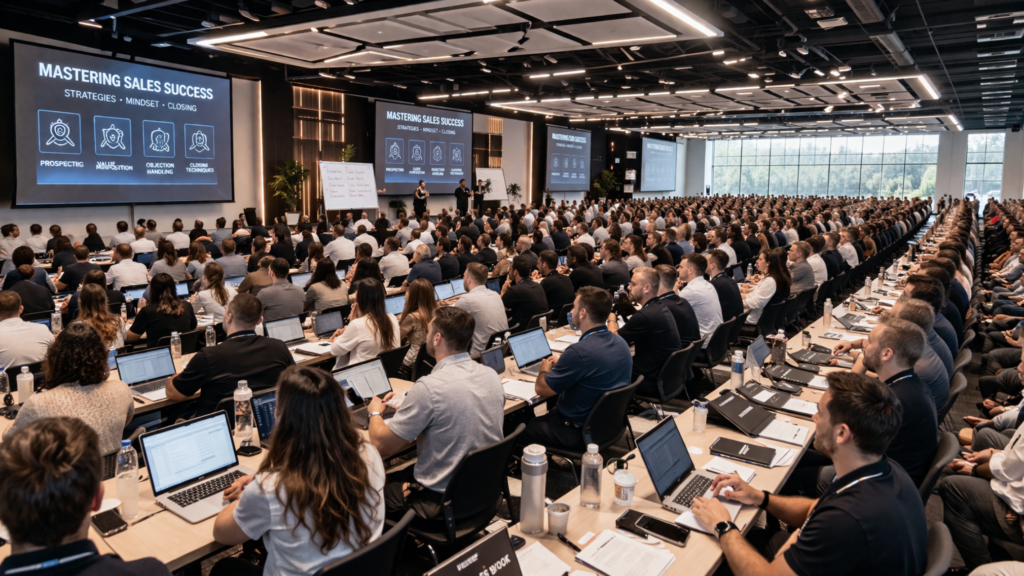
The sales training industry has evolved into what can only be described as a “rep factory”—an assembly-line approach that prioritizes scalability and profit margins over actual behavior change. Major training vendors have perfected the art of packaging generic methodologies into repeatable workshops that can be delivered to thousands of organizations with minimal customization.
This model serves the vendors exceptionally well, generating billions in recurring revenue. But it fails the organizations that buy it, producing temporary enthusiasm without lasting transformation. The rep factory treats every salesperson as interchangeable, every sales environment as identical, and every learning need as solvable with the same two-day workshop.
The result is an industry that has become extraordinarily efficient at delivering training that doesn’t work. Understanding how we got here—and why the model persists—is the first step toward demanding something better.
The Assembly Line Emerges
The modern sales training industry emerged in the 1980s and 1990s around a simple, scalable business model: develop a proprietary methodology, package it into a standardized workshop, train facilitators to deliver it consistently, and sell it to as many companies as possible.
This model worked brilliantly—for the vendors. They could create content once and monetize it indefinitely. They could train relatively junior facilitators to deliver scripted workshops. They could serve Fortune 500 companies and mid-market firms with essentially the same product. Margins were excellent, and growth was limited only by sales capacity.
The assembly line produced genuine innovations in its early years. Consultative selling, solution selling, and strategic selling frameworks gave salespeople structured approaches that represented real improvements over the ad-hoc methods that preceded them. The first generation of trained sellers often did outperform their untrained peers.
But over time, the model calcified. What began as innovative thinking hardened into orthodoxy. The methodologies stopped evolving as the economics of the business favored consistency over improvement. Why invest in R&D when the existing product sells perfectly well?
How the Factory Operates
The rep factory model follows a predictable playbook that has become the industry standard.
Development happens once, at corporate headquarters, by methodology experts who may not have sold anything in years. The content reflects what worked in the past, filtered through the lens of what’s easy to teach and deliver. It’s optimized for facilitator consistency, not learner outcomes.
Packaging transforms methodology into modules—typically two to three days of workshop content with accompanying materials. The package is designed to feel comprehensive while fitting into the scheduling constraints of busy sales organizations. Convenience trumps effectiveness.
Delivery relies on certified facilitators who follow detailed scripts and timing guides. Good facilitators can make the experience engaging, but they’re not empowered to fundamentally adapt the content to the specific challenges of each organization. They’re performers executing a production, not coaches diagnosing and solving problems.
Certification gives the illusion of quality control. Facilitators must demonstrate they can deliver the content as designed. But certification tests adherence to the methodology, not ability to change behavior. A facilitator who perfectly delivers ineffective content is still certified.
Measurement focuses on what’s easy to track: attendance, completion, satisfaction scores, post-test knowledge assessments. These metrics serve the vendor’s need to demonstrate value without actually proving it. As long as participants enjoyed the workshop and can recite the framework immediately afterward, the training is deemed successful.
The Commoditization Death Spiral
The rep factory model created conditions for commoditization that have degraded the entire industry.
As methodologies became standardized, they became harder to differentiate. SPIN, Challenger, MEDDIC, Sandler, Miller Heiman—to a busy sales leader evaluating options, they can all sound similar. They all promise better discovery, stronger qualification, more consultative approaches. The differences are often more theological than practical.
This similarity drove competition toward price and convenience rather than outcomes. Vendors competed to deliver training faster, cheaper, and with less disruption to selling time. The winners were those who could run the most efficient factories, not those who produced the most behavior change.
The race to the bottom created pressure to cut corners. Workshop durations shrank from five days to three days to two days to half-day “intensives.” Customization—which requires expensive research and development—was minimized. Follow-up reinforcement, which doesn’t scale well, was either eliminated or turned into a separate product that few clients purchased.
Meanwhile, procurement departments got involved, treating training as a commodity to be sourced at the lowest cost. RFPs focused on price, duration, and number of facilitators rather than evidence of behavior change. The buyers weren’t equipped to evaluate quality, so they evaluated what they could measure.
Why Organizations Keep Buying
Given the well-documented failure rates of traditional training, why do organizations keep purchasing from the rep factory?
Familiarity creates comfort. Sales leaders know these vendors—they’ve attended their workshops, read their books, maybe even been certified in their methodologies earlier in their careers. Choosing a known brand feels safer than trying something new.
Career risk aversion plays a major role. “Nobody ever got fired for buying IBM” applies to sales training. If you choose a major vendor and the training doesn’t produce results, you can blame the reps for not applying it. If you choose an unknown alternative and it fails, your judgment is questioned.
Budget cycles favor events over systems. Most organizations budget for training annually, expecting to spend the money on discrete events. A sustained development program that spans quarters doesn’t fit neatly into how budgets are allocated and measured.
Vendor sales skills shouldn’t be underestimated. The major training companies are very good at selling. They know how to create urgency, build relationships, navigate procurement, and close deals. Their sales effectiveness stands in ironic contrast to the ineffectiveness of what they’re selling.
The measurement problem provides cover. Because most organizations don’t know how to measure real training outcomes, they can’t definitively prove the training failed. The vendor can always point to the reps who did succeed as evidence that the methodology works “when properly applied.”
The Human Cost of the Factory
Behind the business model are real consequences for the people processed through the rep factory.
Salespeople invest time and emotional energy in training experiences that promise transformation. They take notes, participate in role-plays, and leave with genuine intention to sell differently. When the training doesn’t stick—when they find themselves reverting to old habits within weeks—many blame themselves rather than the system.
This creates cynicism that makes future development harder. Reps who’ve been through multiple ineffective training programs become skeptical of all training. They show up physically but not mentally. They go through the motions without believing anything will change.
Sales managers inherit responsibility for reinforcing training they weren’t equipped to reinforce. Most received no training on how to coach to the methodology. They’re told to observe calls and provide feedback but given no framework for doing so effectively. Their failure to sustain the training becomes another excuse for why it didn’t work.
Organizations develop learned helplessness about sales development. They’ve tried so many programs without lasting results that they lower their expectations. Training becomes something you do because you’re supposed to, not because you expect it to transform performance.
What the Factory Can’t Produce
The rep factory model is structurally incapable of producing certain outcomes, regardless of how good the methodology is.
Individualized development requires understanding each rep’s unique strengths, weaknesses, and behavioral patterns. The factory delivers the same content to everyone because customization doesn’t scale. But adult learning is inherently personal—what one rep needs is completely different from what another needs.
Sustainable behavior change requires sustained intervention. The factory delivers an event and moves on. But habits formed over years of selling can’t be rewired in two days. Real change requires months of reinforcement, practice, feedback, and coaching.
Pressure performance—the ability to execute new skills when stakes are high—requires practice under realistic pressure conditions. The factory provides low-stakes role-plays with peers, which don’t trigger the stress response that real sales conversations create. Reps can perform beautifully in training and freeze with actual prospects.
Manager capability development is outside the factory’s core product. The factory trains reps, not the managers who need to coach them daily. This ensures that whatever behavior change occurs in the workshop dissipates quickly once reps return to managers who don’t know how to reinforce it.
Organizational culture change is beyond what any workshop can accomplish. The factory can teach new techniques, but it can’t transform the environment in which those techniques must be applied. If the culture rewards behaviors that conflict with the training, the culture wins every time.
The Alternative Model
What would sales development look like if it weren’t designed around the economics of the rep factory?
Development would be a system, not an event. Instead of two-day workshops, organizations would invest in 90-day programs that include initial learning, ongoing reinforcement, deliberate practice, coaching, and measurement. The timeline would match how the brain actually forms new habits.
Content would be adaptive, not standardized. Technology would enable personalized learning paths based on individual skill gaps and behavioral patterns. A rep struggling with discovery would get different development than one struggling with negotiation, even if they’re on the same team.
Practice would simulate real pressure. Instead of friendly role-plays with colleagues, reps would practice in environments that trigger realistic stress responses—AI-powered simulations, recorded scenarios with real stakes, or structured practice with managers trained to provide genuine challenge.
Measurement would focus on behavior and results. Instead of satisfaction scores and knowledge tests, programs would track whether reps actually sell differently—and whether that difference shows up in their numbers. Vendors would be accountable for outcomes, not just delivery.
Managers would be developed first. Before training any reps, organizations would ensure their managers had the skills and tools to reinforce whatever the reps learn. This inverts the typical sequence but dramatically increases the probability of lasting change.
The Economic Reality
The alternative model exists. Companies like Braintrust have built approaches that produce measurable, lasting behavior change. But they require different economics and different expectations.
Programs that actually work cost more upfront because they’re sustained over months, not days. They require more senior talent because individualized coaching can’t be scripted. They demand better technology because personalized practice requires sophisticated platforms.
But the total cost of ownership is often lower because you’re not buying the same training over and over. Organizations that invest in neural rewiring don’t need annual methodology refreshers. They don’t cycle through vendors looking for something that works. They develop capability once and build on it.
The rep factory persists because it’s optimized for the wrong metrics—vendor profitability and buyer convenience rather than actual outcomes. Until buyers demand evidence of behavior change and refuse to pay for training that can’t demonstrate it, the factory will keep running.
Breaking Free
For sales leaders ready to escape the rep factory, the path starts with different questions.
Ask potential vendors what percentage of their revenue comes from repeat business with the same clients buying the same training. A high number suggests the training isn’t producing lasting change. If it worked, clients wouldn’t need to keep buying it.
Ask for behavior change data at 90 days, not satisfaction scores at day two. If a vendor can’t provide this, they either don’t measure it or don’t like what they’d find.
Ask how the program accounts for individual differences in learning needs and behavioral patterns. If the answer is “the methodology works for everyone,” you’re looking at factory output.
Ask what role your managers will play and how they’ll be equipped to play it. If managers aren’t central to the program design, reinforcement isn’t going to happen.
Ask whether the vendor is willing to tie any portion of their compensation to measurable outcomes. Their willingness—or reluctance—tells you everything about their confidence in what they’re selling.
The rep factory won’t change itself. It’s too profitable the way it is. Change will come from buyers who refuse to accept commodity training and demand evidence of results. Until that happens, billions will continue flowing into an industry optimized for everything except the one thing that matters: actually making salespeople better.